
Defying Gravity
Wicked, Wizard of Oz, and the Power of Cinema (Part 2)

The irony of it all didn’t get past me.
Now screening at The Sphere is the spectacular remake of the G-rated 1939 film - The Wizard of Oz. The classic movie, themed to highlight intelligence, heart, courage, home, and the hazards of chasing after an illusion, is making a major impact in - of all places - Las Vegas.
Twice per day, the two-hour extravaganza draws a massive audience willing to pay a hefty premium for a seat. That now includes Carolyn and me.
In my last Substack piece, I unpacked the classic story.
As of this writing, we’ve experienced it. The Sphere.
Wow.
Yes, “Sin City” (as my Grandfather called it) emerged out of the desert as a gambling and entertainment Mecca. Every hotel on The Strip has an over-the-top ploy to attract customers - New York’s Statue of Liberty, the Eiffel Tower, the Strat’s X-Scream (dangling you over the edge, 866’ above ground), the Pyramid, the High Roller (the highest [well, now the 2nd highest] Ferris wheel in the world), Bellagio’s Dancing Waters, and in December, Christmas on steroids - everywhere. But the grand-daddy of them all is - The Sphere.
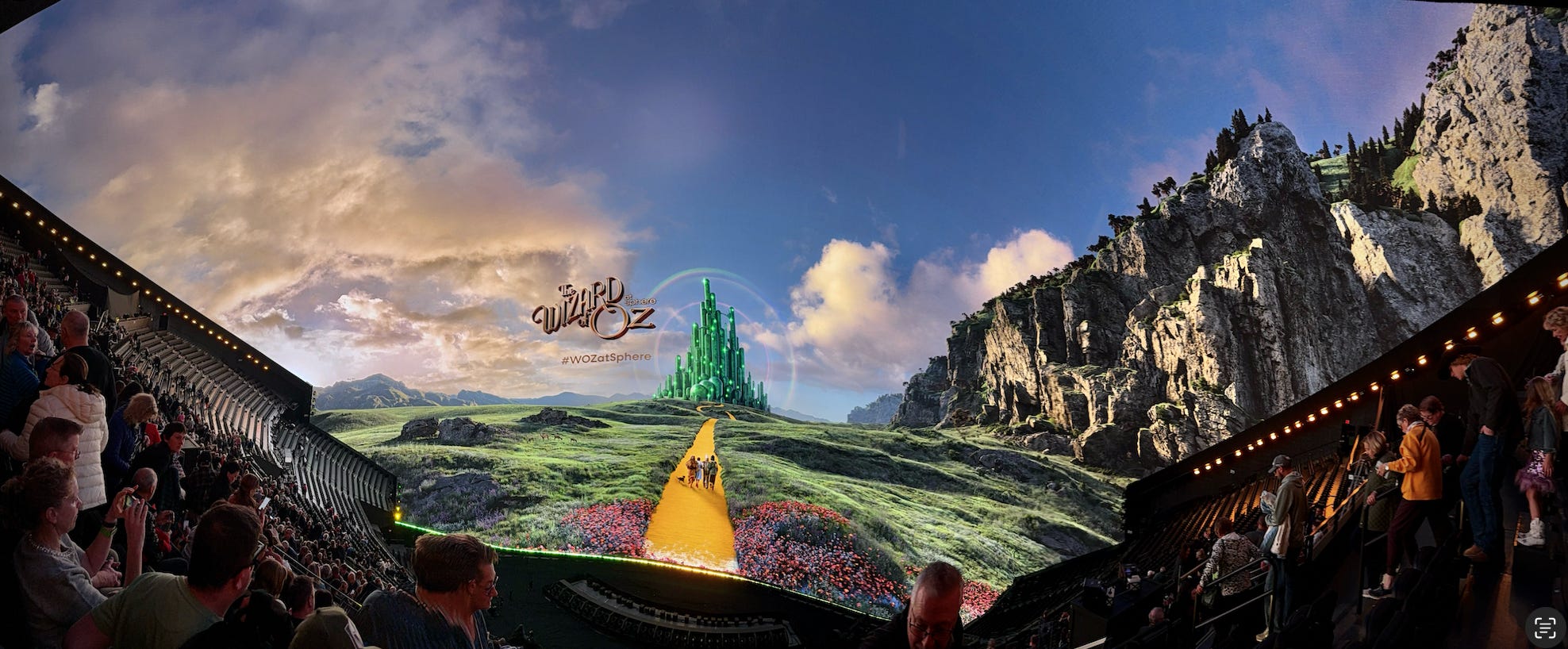
It’s a massive globe. The entire surface is a colossal video (LED) screen they call the Exosphere. It’s perfectly round, 366’ tall and over 500’ in diameter. It seats over 18,000, and the interior globe is nearly all a seamless 16K high-resolution video display. Before this, I considered IMAX to be the pinnacle of cinematic awe. But I hadn’t yet experienced The Sphere.
On the outside, it can be the Moon. Or planet Earth. Or splash art in motion. Or flying dragons. Or candy canes and bright ornaments flashing in red and green. Or a promotion for the Wizard of Oz. Visible for miles. In motion. All day. All night.
Inside, it’s like the heavens that were once considered to be a celestial dome. You are surrounded - left/right and up/down; the sound, too - big rattling boom woofers and piercing trumpet highs. The voices are full and rich and clear. The haptic seats rattle, too, in synch with the thunder and the blast of an explosion or the shaking of hurricane-force winds. So when Dorothy is hit by a tornado, that torrent of wind blows on you, too. It’s as though you are caught up with her in the eye of the storm then finally, when it all ends, you set down in the magical world of Oz.
Words can’t explain it. Maybe it’s because I really am an old guy. But throughout the film, I felt strong emotion - a hot choking up in the throat and warm tears forming on the edge of my eyes. That first moment when the heavens filled with light, the image of a Kansas farm, all in sepia; the matching swell of sound and the wonder of it all, well, it got me. That’s before Dorothy stepped into the Technicolor world of Munchkinland. When she did, well, that got me, too.
We looked around that massive audience in the theater right there in Las Vegas. The absence of people of color became conspicuous. Most all of us were white. And the clear majority would quite easily qualify for those senior discounts. No questions asked. Watching the film, the cast matched our audience. Not one person of color from beginning to end. Hmmm.
I won’t rehearse the story again, but I will say this. The connection I made between the Wizard (who turns out to be a frightened little man with a microphone behind a green curtain) and our current President was only confirmed. I did a little research, thinking that the movie makers in 1939 may have seen the connection between the Wizard and the Fuhrer, taking Germany into a disastrous World War. I found no evidence of that. But I did learn that Frank Baum, when he crafted the Novel in 1900, wrote in the Yellow Brick Road and the magical Silver Slippers (red in the movie) as a symbol of William Jennings Bryan’s argument over the dollar. He preached that the government’s guarantee of the U.S. currency by the gold standard (Yellow Brick Road) should be enhanced by an additional “silver (slippers) standard.” (See his “Cross of Gold” speech.)
For Baum, the Wizard did, in fact, represent politicians and business barons who had an inflated view of their own power and influence. For me, as the Wizard presented himself as this larger-than-life, intimidating, fire-breathing, threatening, fear-inducing, brute of an ogre - I couldn’t help but think that his actual identity as a frightened little pretender matched my view of our man in the gilded White House.
But I did miss one thing, now that I’ve seen the movie again. I’d forgotten that the Wizard, after he’s exposed as the guy from Omaha, transforms into a kind of power-of-positive-thinking preacher - identifying the brain in the Scarecrow, recognizing the heart in the Tin Man, and calling out the courage in the Lion. He gave them symbols to represent this acknowledgment - but mainly, it was the power of suggestion. Each of them already possessed the quality they sought; they just didn’t know it. No magic required.
And Dorothy, well, she makes her way home. Turns out, Oz was only a dream. An intensely vivid dream.
Watching it again, there in The Sphere, filled me with gratitude, too. For intelligence. For heart. For courage.
For home.
* * * * * * * *
I’m not the first to notice the whiteness of the 1939 movie. In 1975, Broadway introduced an all-black version called The Wiz, a celebration of black culture and creativity with the hit song, “Ease on Down the Road.” Then in 2003, Wicked appeared on Broadway at the Gershwin Theater. For twenty years, it’s been one of the longest-running plays in Broadway history. Over 70 million people have seen the play worldwide, including Carolyn and me.
After more than a decade of planning, the film version of Wicked was produced and released in 2024 under Director John M. Chu - in two parts. Last week, in anticipation of our visit to The Sphere, we took in part two - Wicked for Good.
Both the Broadway play and the film are explorations of the significant dynamics of social and cultural “othering.” The 1939 film had little to do with the challenges of race. But the exploration of Oz’s backstory takes a deep dive into the background of the characters. It’s a social and political commentary. The entire cast is wildly diverse. And it all started with the 1995 innovative novel by Gregory Maguire - Wicked: The Life and Times of the Wicked Witch of the West.
The story is a retrospective, a prequel to The Wizard of Oz. It imagines origins - the Witches (Elphaba and Glinda), Munchkinland, the Wizard, the Emerald City, the flying monkeys, the Enchanted Forest, and all.
In Wicked for Good, the Wizard (played brilliantly by Jeff Goldberg) is a dead ringer for Donald Trump. He is a powerful and corrupt dictator. His power derives from his bold lies, stirring up fears and producing propaganda to keep Munchkinland subservient to his every whim. Elphaba (The green Witch) is a scapegoat - the Wizard blames her for all the ills of Munchkinland.
Glinda, the Good Witch, is perky, energetic, and very white, usually dressed in pink. She’s obsessed with appearances and popularity, a product of Shiz University. She represents the drive for perfection. But in this version of the story, unlike the two-dimensional characters of the 1939 movie, she is complicated. Most every character is complex - conflicted, torn between the pressure to conform and the need to be true to one’s self. All of the cast, including Glinda, have a shadow side.
Perhaps the most human of them all is Elphaba, embodied with unparalleled talent by Cynthia Erivo. To underscore the director’s commitment to diversity, under Elphaba’s green skin, the actor, Cynthia, is a black woman. She defies gravity.
If you’ve only seen the 1939 movie, you would not imagine that the relationship between Glinda and Elphaba would be the primary storyline for Wicked. But it is.
When Elphaba arrives at Shiz, she is immediately “othered.” She doesn’t fit. She’s green. Glinda takes her on as a project. The premise would be that Glinda would teach Elphaba how to assimilate seamlessly into the life of Shiz and then Munchkinland and Oz. But in time, it’s Elphaba who exposes Glinda’s shallowness and her disguised unhappiness. Glinda’s efforts to exude perfection are a cover for a young woman who just doesn’t know herself. The Prince, Fiyero, sees it. At first engaged to Glinda, he comes to prefer the honesty, independence, and confidence of Elphaba. Madam Morrible sees it, too. Elphaba’s candor and self-awareness make her a candidate for training in magic. Glinda is dismissed as second string.
The Wizard and his assistant, Madam Morrible, combine forces to keep Munchkinland pure and separate from any influence that would diminish their power and control. They imprison the animals because they are different and represent a threat. They are also scapegoats, blamed for the nation’s problems. The professor, Dr. Dillamon the goat, was a free-thinker who challenged the assumptions of the Wizard’s propaganda and lies. Deemed the enemy of Oz, he, too, was jailed and assigned to hard labor.
The Wizard may just have well worn a bright red cap: Make Oz Great Again. Oz First.
In the end, Glinda realizes that Elphaba is the best thing that’s happened to her. She thought she would be Elphaba’s teacher, but she had it backwards. And in the end, it’s Elphaba who schools Glinda.
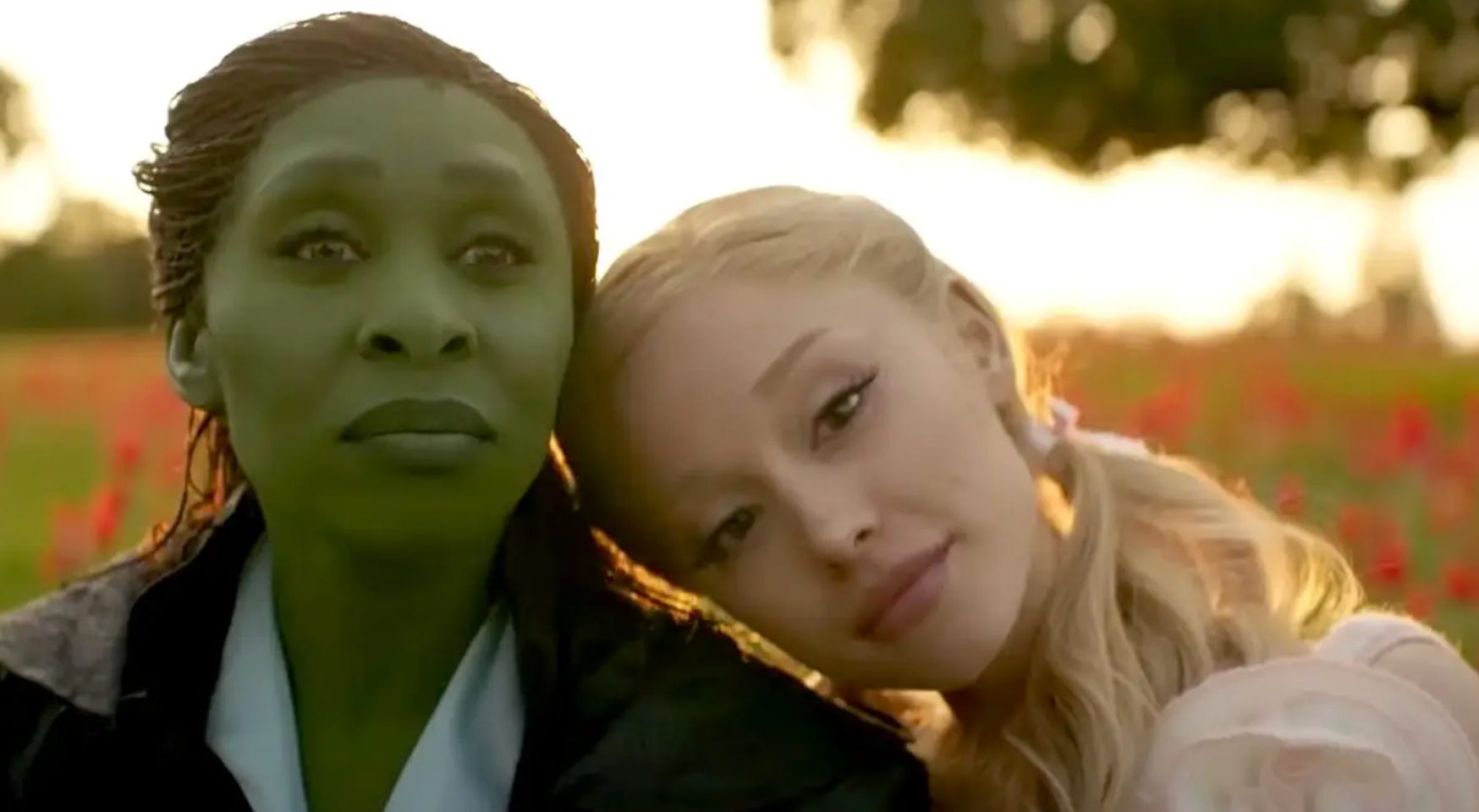
Finally, they sing beautifully together - “because I knew you, I have been changed… for good.”
* * * * * * * * *
Art can change us. There’s magic in the cinema. The collaboration of technology, artistry, color, orchestration, movement, and surprise can move me. It certainly did at the Sphere and on stage, and in the theater with Wicked.
I was reminded of the beauty of friendship. How the dark shadow of power and control and ambition and corruption and abuse can infect us all and rob us of the most meaningful of all relationships.
Overcoming all that, seeing past it, embracing what is right here and right now, is what made me so emotional as I witnessed these films; these performances. They got me.
No place like home.
Because I knew you.
It made me think of you… those of you who track my writing. Check in to my podcast. Engage in conversation. Share your stories. Drop your guard.
Because of you, I am moved when I contemplate these words, this sentiment, this Christmas season…
I do believe I have been changed for the better
And because I knew you…
I have been changed
For good.
-----END----
And check out YellowBrickRoad (2011) by Jesse Holland and Andy Mitton for a very dark perspective
of the road and Oz.