
Remembering Dr. Ron Rietveld
A Lincoln Scholar and Beloved Professor Leaves a Legacy

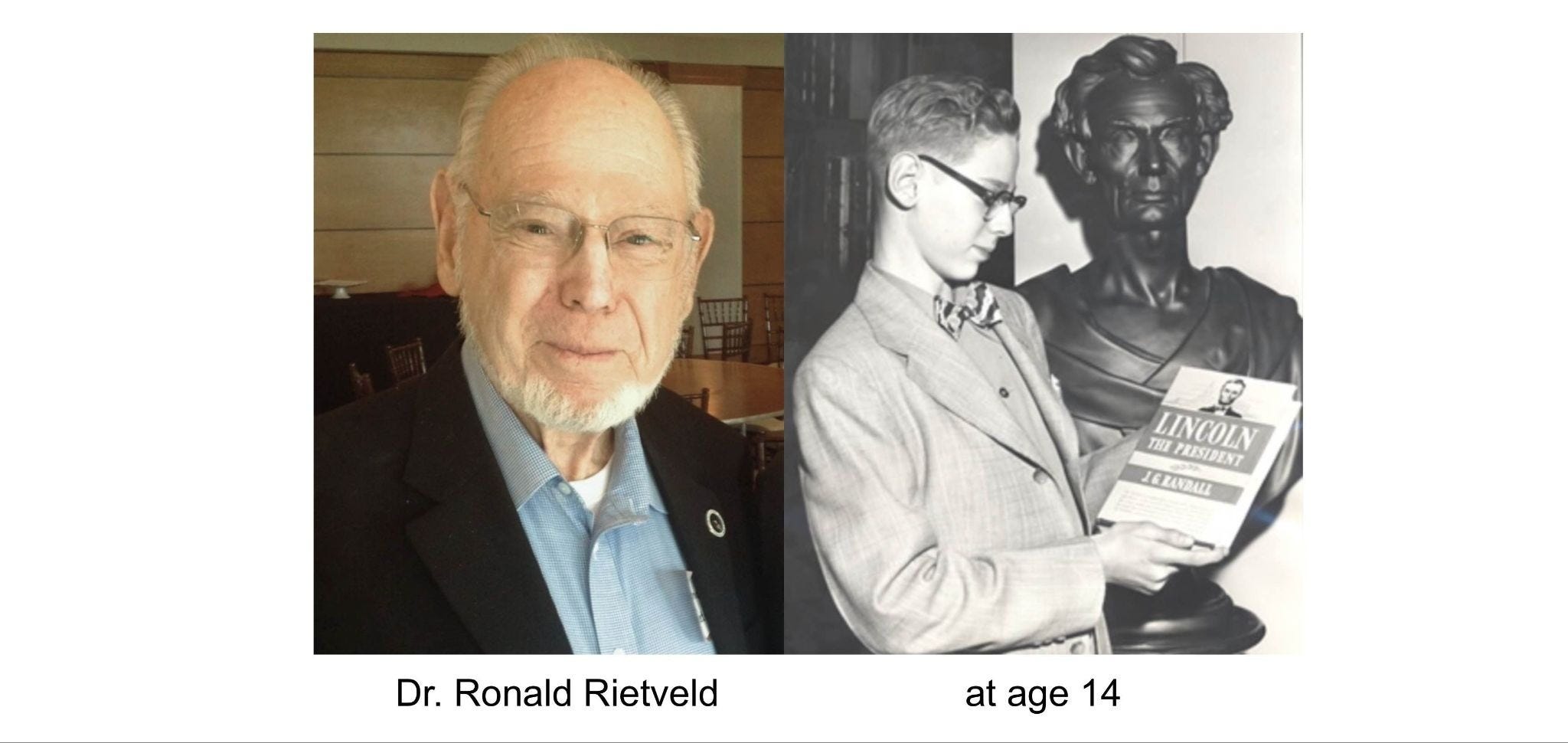
Last month, the history department at California State University in Fullerton hosted a memorial for a beloved professor of history, Dr. Ronald Rietfeld. Not only did I know his reputation as a celebrated Lincoln and Civil War scholar, but I also knew him as a friend (and long-time client in my former life).
It was an honor for me to be asked to share some thoughts that day, held on the top floor of the Pollack Library on campus. I found myself in the company of Dr. Rietfeld’s distinguished faculty colleagues, scholars, and teachers, as well as Ron’s son, Dr. James Rietfeld, who is an exceptional scholar in his own right. Ron’s wife Ruth, also a dear friend, flew in from Iowa to attend.
As I put my thoughts together, knowing the context, frankly, I felt rather intimidated. It was sophisticated company. What came into focus for me is Ron’s remarkable legacy. It was more than inspiring. His life was and is a timely example of what we need in the anti-intellectual, polarized world we live in today.
I decided that it’s something I want to share with you.
Here it is (pretty much) as I delivered it.
-----------------
I am honored to be here today among these distinguished guests - especially Ruth and James - to remember a remarkable human being - a scholar, a colleague, a husband, a dad, a grandfather, a person of deep faith, and a friend, Dr. Ronald Reitveld.
I want to express my thanks to the University for hosting this event.
Today, some of you have come to the Pollack Library at California State University, Fullerton, to remember the life and legacy of an esteemed professor and valued colleague, a history lecturer, a Sunday morning Bible teacher, a travel host who visited historical sites all over the United States, a husband, a Grandfather, a Dad, or a neighbor.
I know him best as a tax client. I prepared his tax returns for many years.
I hesitated to tell you this. Whenever I mention that I prepared taxes as part of my career résumé, folks are inclined to tell me their tax stories or seek my advice. Just know that I sold my business in 2004. I’m the last person you want to rely on for tax advice.
That said, a tax preparer has a unique insight into his or her client’s life - we know a whole lot about the person that the rest of the world would not necessarily know. Maybe not as much as a therapist, but almost.
So every year, Ron, Ruth, and I would meet and go over the numbers. Thankfully, Ruth had things together, and we would dispense with the number-crunching quickly. Doc, the consummate storyteller, would entertain us for the remainder of the hour. I always looked forward to that appointment. Ron would talk about Springfield, Civil War sites, Washington D.C., museums, research libraries, Holland, and of course, Pella, Iowa.
Carolyn and I have had an affection for Carnegie Libraries all over the country. One of our favorites is in Silverton, Colorado. Another is in picturesque Port Townsend, Washington, right on the bluff overlooking the beautiful Puget Sound.
When we were there vacationing with our family one year, we discovered a complete set of LIFE MAGAZINES right there in Port Townsend. It filled an entire section of the classic, old library. We looked at each other in amazement as though we had made a terrific archeological find. We asked, “Gosh, do you think we might find that article about Doc Rietfeld’s discovery of the last Lincoln photo - the one with Abraham Lincoln in the open casket with the guards standing by?”
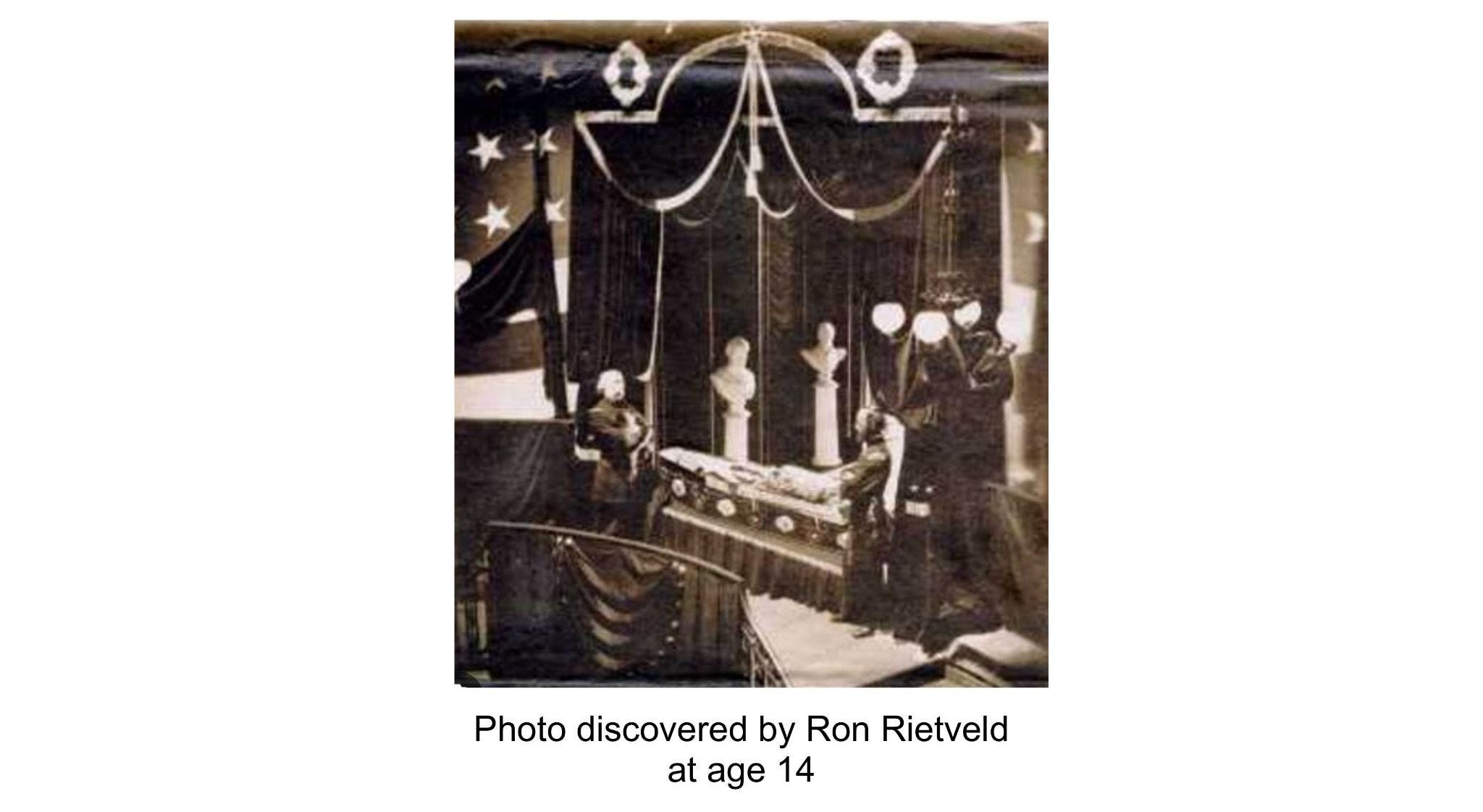
We went on the hunt. And sure enough, after a long search, we found the April 14, 1952, issue. And then the March 30, 1954 issue that included the now iconic, grainy Lincoln photo and its discoverer, 14-year-old Ron Rietveld. We were so excited. We made copies and mailed them off to Doc.
For young Ron, that heretofore unknown photo was a fateful find. That photo was hidden in a long-ignored file because Mary Todd Lincoln demanded that the guards on that final cross-country tour prohibit any photos of her assassinated husband. But someone violated the rule then hid the photograph, unseen for nearly one hundred years.
That unlikely discovery by a young high school student launched a career that has inspired hundreds of us, including many of the scholars in this room.
It’s my conviction, a conviction shared by many, that the liberal arts have been undervalued for a long time in our pragmatic country. For too many, higher education is a utilitarian means to an economic end - which major will yield the highest-paying job? Anything that doesn’t contribute to that goal is a waste of time, energy, and money.
Like Doc Rietfeld, my academic career began with Bible college. When I graduated from high school in 1966, I was accepted at Cal State Fullerton (the head count that year, as I remember, was only 6,000) - but I chose instead to go off to Chicago for Bible training. For eight years, I was a full-time student - six of those years studying Bible and theology.
But for the next two years after Bible school, I somehow got myself into UCLA, again - full-time, I took those lower division classes - “Breadth Requirements.” It was my initiation into the Liberal Arts. In those tumultuous years, 1969-1971, I immersed myself in introductions to psychology, sociology, literature, philosophy, geology, biology, French, chemistry, astronomy (not to be confused with astrology), and history. Looking back, those were some of the best years of my academic life. It set me up for a lifetime of learning. And to appreciate Ron Rietveld.
Doc Rietveld was an historian. A Lincoln scholar. A scholar of the Civil War. If asked, Doc would certainly affirm that history is the crown jewel of the Liberal Arts.
A scholar is expected to have answers, but more than that, to ask perceptive, piercing, probing questions. Doc possessed an insatiable curiosity. He wanted to know more. His quest for knowledge lasted a lifetime.
He understood that higher education exists for much more than future employment. Those years spent in any of the liberal arts cultivate the life of the mind, the stimulation of curiosity, the value of scholarship, the mastery of the disciplines, and an understanding of and a commitment to the common good.
Doc Rietveld had a kindred spirit in his colleague and associate, the late Dr. George Giacumakis - who was also a long-time and dear friend of mine. Dr. George, you may remember, served for years as Director of the Irvine Campus of Cal State Fullerton over there on what once was called the El Toro Marine Base. Both earned their PhDs. Dr. Ron at the University of Illinois (Lincoln’s home state) in Urbana, Dr. Jake at Brandeis.
Together, over the decades, Doc Rietveld and Doc Jake contributed to a university that would become a major California institution of higher learning with a sterling national reputation.
And then, there was that life-long friendship with Corrie Ten Boom - the Dutch woman whose family in Haarlem, the Netherlands, hid Jewish families in a back room of their home during the Nazi occupation. In 1944, the Hiding Place (the name of her famous novel), was breached by armed soldiers. They broke into their home and carted the entire family off to concentration camps. Corrie survived. But not her family.
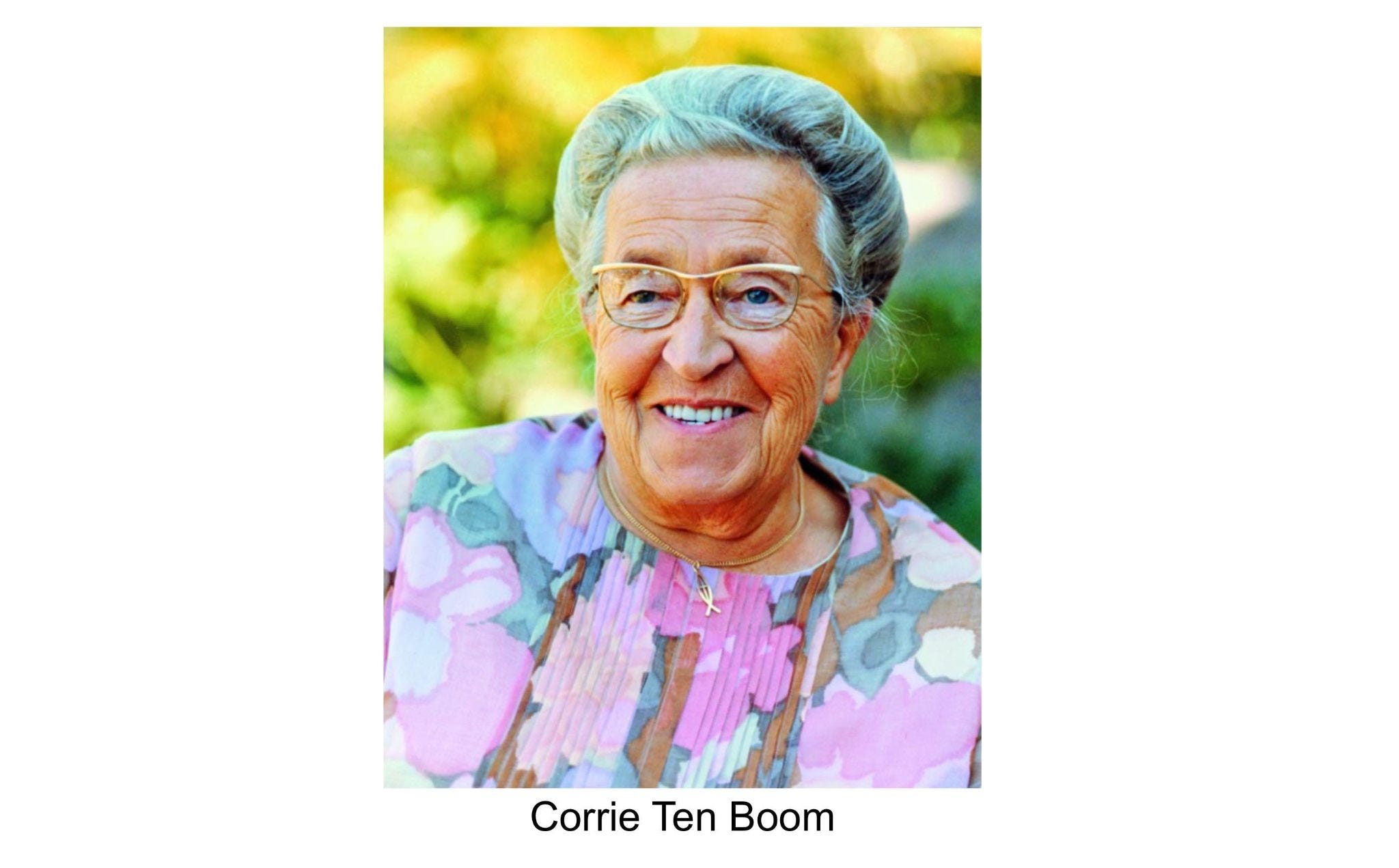
The Rietvelds became close personal friends with Corrie, traveling annually to the Netherlands to spend long hours together.
This is the company Doc kept.
I was honored to know him.
We live in a polarized world. It’s nothing new, really. Think about World War II and Corrie Ten Boom. I reflect on my years at UCLA - the Vietnam War, the Civil Rights legislation, Watergate (the President resigned), feminism, Roe v. Wade, Kent State, and the generation gap.
Today, we feel that polarization. We are a divided nation. Us versus them. Left versus right. Pro versus con.
Doc Rietveld would remind us - if we want to understand our polarized world, we need to study the Civil War. The Mason-Dixon line lives. It is still with us. But we should also get to know who Doc would call the greatest President in history, the one who wrote these words regarding our country, “a nation conceived in liberty and dedicated to the proposition that all men [persons] are created equal.”
We too easily think in binary terms - us and them. For Doc, the “other” was not someone to hold in contempt. The “other” is one to be understood. Doc, as a historian, was a truth-seeker. And in that role, he was a reconciler.
The philosopher Martin Bubar didn’t use the phrase “Us versus Them,” he talked about I-It and I-Thou. When we think of the other as an “it,” an object, there is distance, indifference, suspicion, contempt. But when the other is a “thou,” a subject, there’s opportunity for affection, mutual respect, understanding, co-operation, and even reconciliation.
Dr. Rietveld was an “I-Thou” person in the best sense of the term.
I believe that’s why I liked him so much. If you were his student, I believe that’s why you were energized and motivated to become a scholar, like him. If you were his colleague, that’s why you looked forward to the next conversation. If you travelled with him, that’s why you just couldn’t get enough; you wanted more. If he were your Dad, your Grandfather, your friend, your neighbor, that’s why you feel the loss so deeply today.
This is Dr. Rietveld’s legacy. He knew us all as a “Thou.”
Let us all go now from here and follow his lead.
Thank you, Ron.
This was lovely, Ken. So true about the liberal arts. Not to mention some of the anti-science attitudes around. I think of young Honest Abe, plugging away at his books by the light of a pine knot.
Ken,
This left me in tears. How beautiful and how lucky he was to call you Friend.
xo
Carole